Wellness to Stability
Fewer in. More out. Fewer back. The point is not how many people were contacted this month. It is how many are still housed a year from now.
- Prevent
- Engage
- Stabilize
- Place
- Retain
Safety
A park you use after dark. A sidewalk you can push a stroller down. A call that gets answered by the right team, on time. And for the person in crisis on that sidewalk, a way out that actually leads somewhere.
The rule Housing status determines what help we offer. Behavior determines what rules apply.

Why this is personal

"My family experienced homelessness after addiction went untreated. I know temporary hardship, untreated illness, and repeated crisis need different responses, and I know every person deserves a real chance to rebuild."Alexander Stoeber
Dignity means helping someone reach the highest sustainable independence they can. Safety means protecting workers, families, businesses, visitors and other vulnerable people from threat, assault, public drug use, blocked access and repeated harm.
Homelessness is not misconduct. Harmful behavior is. Humanity and order belong in the same policy.
Start with the department's own numbers
Credit first: emergency response is protected, and the conduct record is strong. The gap is capacity, not conduct, and it lands on the calls that shape whether a street feels usable.
| Priority | Target | Average |
|---|---|---|
| 1 · Emergency | 7:00 | 05:37 |
| 2 · Urgent | 14:30 | 13:06 |
| 3 · Routine | 30:00 | 36:31 |
| 4 · Low priority | 50:00 | 50:16 |
Priority 3 is the noise complaint, the theft report, the person who has been in the doorway for three days. Six minutes past target, every time, is what a staffing gap feels like from the sidewalk.
Response times, calls for service, use-of-force and de-escalation figures are the Police Department's own reporting for 2025, presented publicly. Two denominators exist and should never be mixed: 56,439 total calls for service, and 69,121 all CAD calls. The conduct percentages are calculated against calls for service.
Staffing is published in paired form with its date because filled and budgeted move independently and monthly. Filled and budgeted counts from different documents and different dates should not be subtracted from one another. Deployable staffing, which accounts for leave, training and assignment, is a third number the City does not currently publish and should.
These are self-reported figures. Force definitions differ between agencies, so they should not be used for city-to-city comparison.
How the work is organized
They are measured differently because they fail differently. Conflating them is how a city ends up counting activity and calling it progress.
Fewer in. More out. Fewer back. The point is not how many people were contacted this month. It is how many are still housed a year from now.
Clean, lit, open, usable. A public space standard is only real if somebody owns closing the loop when a condition persists.
A contact is activity. A handoff is progress. Durable stability is the outcome. A bus ticket is not a durable exit.
What I would do
Action, owner, cost, deadline, result. No officer headcount, no bed count, no crime-reduction promise. Those are numbers candidates invent because they sound decisive, and a councilmember cannot deliver any of them alone.
Publish what response you should expect, and whether you got it.
Tie staffing requests to service outcomes, not to a campaign number.
Clean, lit, open, usable, with someone who owns the fix.
City money buys outcomes, not activity reports.
The City does not run behavioral health. It can still hold the seam.
Tools that multiply a short-staffed force, with rules written first.
The department published its own list. Put it on a funded schedule.
Fire and EMS staffing, ALS capability, apparatus and station commitments are gated in the campaign's evidence rules until the Standards of Cover, budget and operations assumptions are confirmed. Citing the department's own published priorities is safe. Promising a station, a paramedic count or a delivery date before the study is adopted is not, and it is the kind of promise that quietly becomes a broken one.
Different needs, different pathways
People move between these as their situation changes. Pick one to see the intervention, the destination and the measure.
Rent, a lost job, a family breakdown. Act before a short disruption becomes a long one.
Public-space rules apply the same way across every pathway. The response to conduct is based on the behavior and the risk, never on where someone slept.
Countywide vehicle-dwelling has risen from 675 to 962 people, and about 44 percent of them are employed. That is a working person who lost the housing math, not a stereotype, and it is the reason prevention and rapid rehousing belong at the front of this page rather than at the end.
Make capacity usable
An empty bed is not always an available bed. Funding, medical eligibility, staffing or referral rules may hold it. The public deserves to see the difference instead of guessing.
What the public record shows
Each measure uses its own reporting period and scope. That is the point: the City cannot currently answer basic questions with one consistent set of definitions.
The 2024 point-in-time count for the City.
A count taken once a year cannot tell you whether anyone got better. The proposed dashboard adds monthly outreach, shelter use, treatment handoffs, placements, repeat crisis contacts and retention.
The City's September 2024 report described provider spending separately from estimated City impacts.
The report does not identify that second category as cleanup. Future reporting should separate sanitation, public safety, repairs, outreach, shelter, treatment, housing and administration.
One City reporting scope covered seven contracted beds inside a much larger facility.
This is a contracting problem, not a provider failure. Seven beds is not a facility, and sixteen people is not a program. Programs serve different acuity levels and should be compared on utilization, turnaways, positive exits, retention and cost, never by treating one agreement as a verdict on an organization.
Fire Department overview, 2025 data.
Seven in ten calls are medical. The department has published what it wants next. The Council's job is to put that list on a funded schedule rather than to invent a different one.
Every figure should carry its geography, reporting period, numerator, denominator, update date, and whether it describes capacity, activity or an outcome.
Point-in-time counts, City-funded programs, provider reports and department reports describe different populations and scopes. They are labeled here and should never be combined without a consistent denominator.
The sequence
Publish the baseline: response by priority and area, paired staffing, bed ledger, public-space standards, and shared outcome definitions across every funded contract.
Priority 1 inside seven minutes and Priority 3 inside thirty. Crisis outcomes visible and improving. Oversight reporting intact as capacity grows.
Residents know what standard applies and can see whether it is met. A person in crisis enters a clear pathway. Public spaces stay compassionate and usable at the same time.
The plan at a glance
Crisis to care to housing to lasting stability, with public spaces working and the results published.
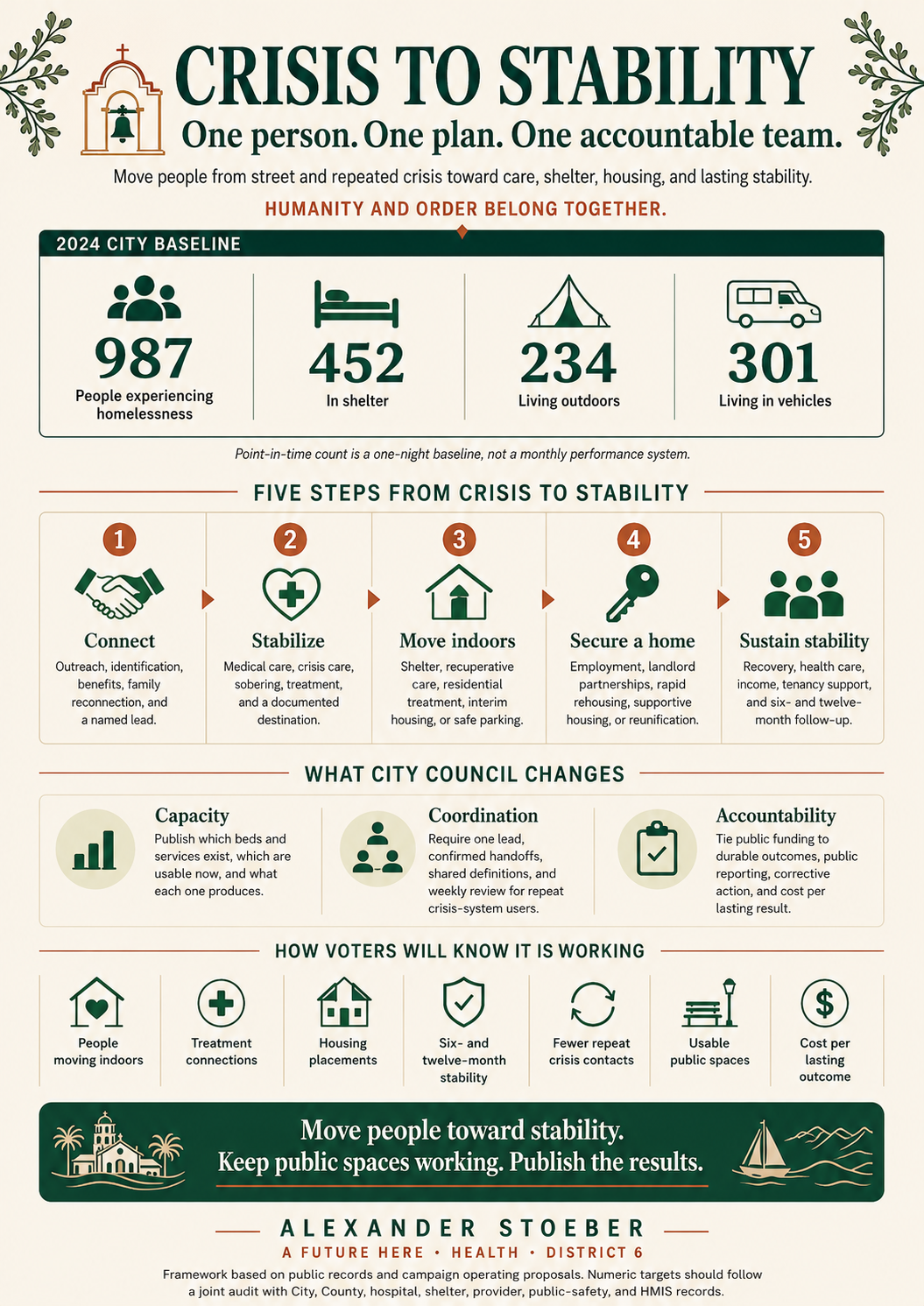
Select the graphic to open it full size.
Be honest about the levers
Santa Barbara uses a council-manager government. One councilmember cannot direct a department. What a councilmember can do is set priorities, write ordinances, pass budgets, condition contracts, and require that results be published.
The public scorecard
Baselines get audited before numeric targets are adopted. Then the same measures publish every quarter, including the bad ones.
If Priority 3 is still past thirty minutes in 2031, if the bed ledger and outcome contracts are not published, or if a quarter passes with no report, the plan did not work. Accountability only means something when the measurement can embarrass the officeholder.
Straight answers
Yes, in several ways. The change is a shared operating plan: one accountable lead, confirmed handoffs, shared definitions, escalation when nobody responds, and quarterly results tied to City funding.
No, and promising that would be dishonest. The goal is the highest sustainable independence each person can reach. Some people will need long-term supported care. That is still success.
No. Providers keep their organizations, donors and expertise. City-funded work should run on one shared outcomes compact so nobody disappears between organizations.
Offer a real, documented path to care. Apply clear, lawful, behavior-based standards when conduct threatens, assaults, obstructs or endangers others. Repeat cases get coordinated review instead of resetting to zero.
No. Compassion provides treatment, shelter and a path forward. Public safety provides consistent rules and a response when conduct harms other people or takes a shared space away from them.
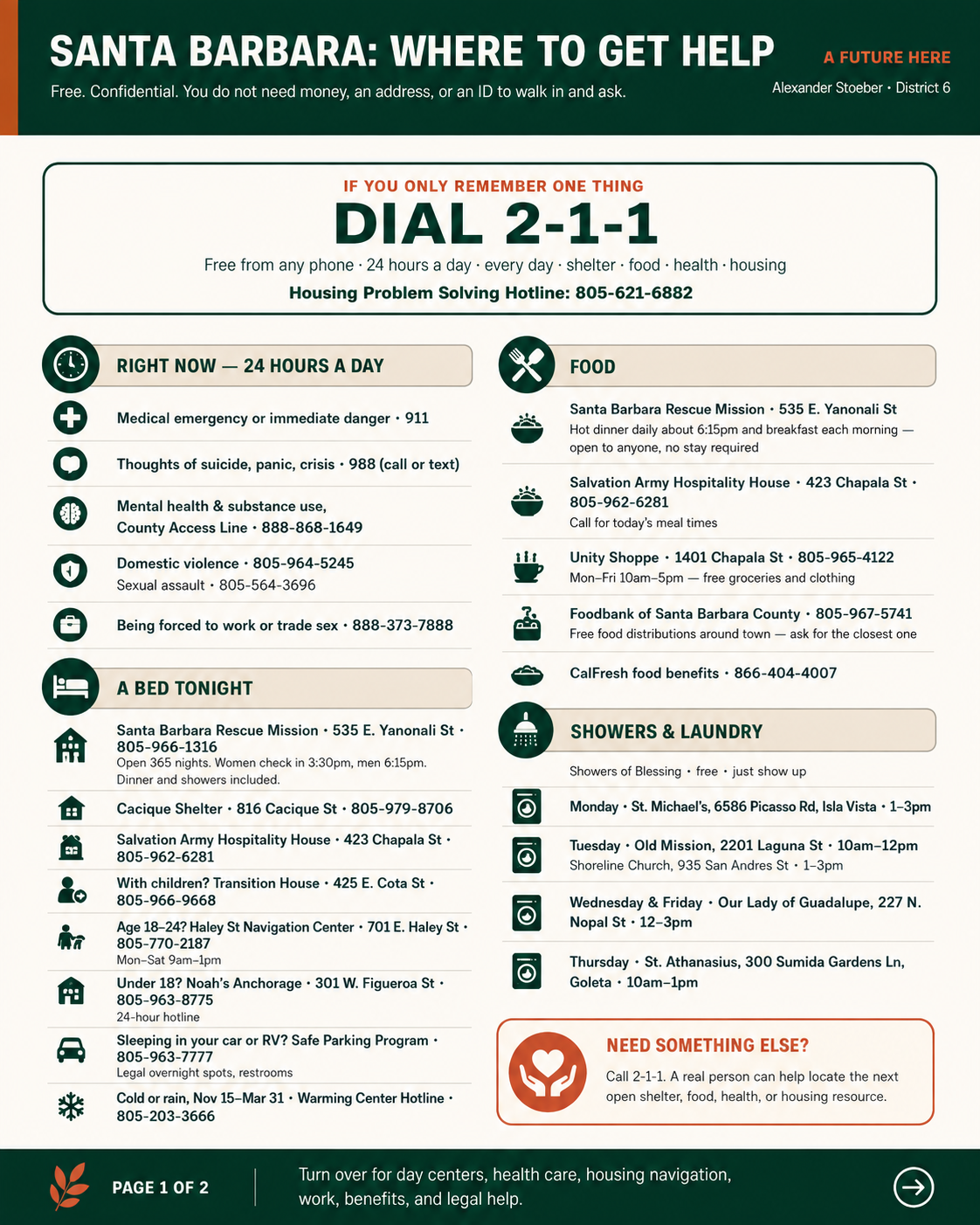
Need more than a phone number?
A two-page local guide to crisis support, shelter, food, showers, health care, housing navigation, benefits, work and legal help.
Start with 2-1-1. A real person can tell you what is actually open when hours and capacity change.
Hours change. If something listed is unavailable, call 2-1-1 for the next open option.
One connected agenda
Rapid rehousing and supportive housing are the exit this system needs at the far end.
02 · State StreetOccupied storefronts, working lighting and foot traffic are safety infrastructure, not decoration.
Take partThe response, the handoff, the shelter, the sidewalk. Specifics beat theories.
Move people toward stability. Keep public spaces working. Publish the results, including the quarters that look bad.
Sources and definitions
Police and fire figures are the departments' own reporting and are described that way. Force definitions differ between agencies, so these should not be used for city-to-city comparison. Staffing appears in paired form with its date because it moves monthly. Numeric performance targets will be finalized after City, County, hospital, provider and public-safety records are audited using consistent definitions. This page is a campaign proposal, not an emergency-reporting channel, and not medical, legal or public-safety advice.